Inside Marathon's 'Smart' Control Panel
How our exclusive control system monitors gas levels, escalates alarms, and protects your team — even when no one is in the building.
Published by Hydrogen Service Bays by Marathon Finishing Systems
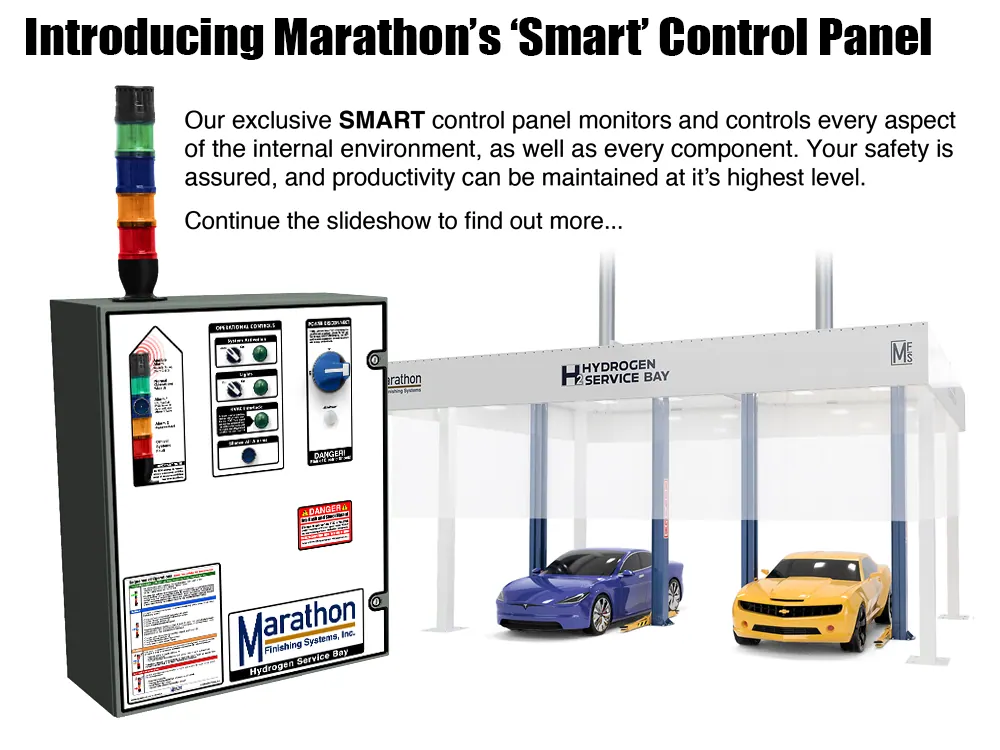
The Marathon Smart Control Panel coordinates hydrogen detection, ventilation, alarms and designated equipment interlocks. Its operating sequence escalates the system response when approved setpoints are reached and identifies critical system faults. The approved project sequence and equipment documentation govern operation, alarm response and restart procedures.
A Service Bay That Watches Itself
Marathon’s Smart Control Panel coordinates the bay’s hydrogen detection, ventilation, alarms and designated equipment interlocks. The approved project design defines the monitored components, operating sequence and response setpoints. It supports a layered approach to risk management rather than replacing technician training or facility procedures.
The Smart panel runs in five distinct operating states. Together, they form a continuous safety loop.
Normal Operations Mode
In Normal Operations Mode, the integrated safety systems constantly monitor the gas level inside the enclosure. The panel will alert users to unsafe gas levels and will take corrective action automatically — without waiting for human intervention.
Alarm 1 — Auto-Purge
If the hydrogen sensor reaches the first alarm setpoint, the system shifts into Alarm 1 Auto-Purge mode:
- Auto-Purge mode turns on automatically.
- The exhaust fan speeds up, removing unsafe gas.
- The enclosure is flooded with fresh air.
- Personnel follow the approved facility alarm-response procedure and the vehicle manufacturer's instructions.
Alarm 2 — Full Purge
If, during the auto-purge, hydrogen continues to rise past 25% of the Lower Flammable Limit (LFL), the system escalates to Alarm 2 'Full Purge':
- An Alarm 2 'Full Purge' is triggered.
- The exhaust fan speeds up further and removes the hydrogen.
- The enclosure is flooded with fresh air.
- Power is discontinued to all interlocked equipment inside the enclosure.
This is the response designed to bring the bay back to a safe state in the most demanding scenario.
Critical Systems Fault
If at any point the Smart system detects a 'Critical Systems Fault':
- The alarm sounds and the lights flash until the fan has been repaired or replaced.
- All documented re-start procedures must be followed before the bay returns to operation.
The fault must be addressed and the documented restart procedure completed before normal operation resumes.
Auto-Mode Is Always On
Auto-Mode can maintain an automatic ventilation response outside normal service operation when configured in the approved control sequence. Availability depends on the required electrical supply and operating system components. Operators must use the project documentation to distinguish an operating-mode change from a complete power isolation or maintenance shutdown.
Why It Matters
Hydrogen safety is not a single sensor or a single fan. It is a coordinated, layered response. Marathon's Smart control panel exists so that response is automatic, repeatable, and always on — across our Automotive, Truck & Equipment, and Bus & Fleet Hydrogen Service Bay product lines.
Hydrogen safety references and planning limits
For background on hydrogen properties, detection and facility safety, consult the resources below. These references do not approve a particular installation. Use the codes adopted by your jurisdiction, the approved project design and the vehicle manufacturer’s service procedures.
- U.S. Department of Energy Hydrogen Program — safety resources
- H2Tools — hydrogen safety information and best practices
- NFPA 2 — Hydrogen Technologies Code information
Planning information from Hydrogen Service Bays, a specialty brand of Marathon Finishing Systems, Inc. About the manufacturer.
Discuss your facility
Our engineering team is ready to evaluate your specific service bay requirements.
Contact an Engineer